


Spain’s Interior Minister Marlaska says the CNI gave no warning before up to 60,000 migrants entered Ceuta, raising questions over border readiness.

Spain’s Interior Minister Fernando Grande-Marlaska said on Saturday, August 1, that the Centro Nacional de Inteligencia (CNI) issued no warning before up to 60,000 migrants entered Ceuta and overwhelmed the autonomous city’s reception and border systems. The claim, reported by La Vanguardia’s account of Marlaska’s appearance in Ceuta, has shifted attention from the immediate response to whether Spain’s national intelligence and border authorities could have anticipated the movement from Morocco.
Marlaska says no intelligence report reached Interior
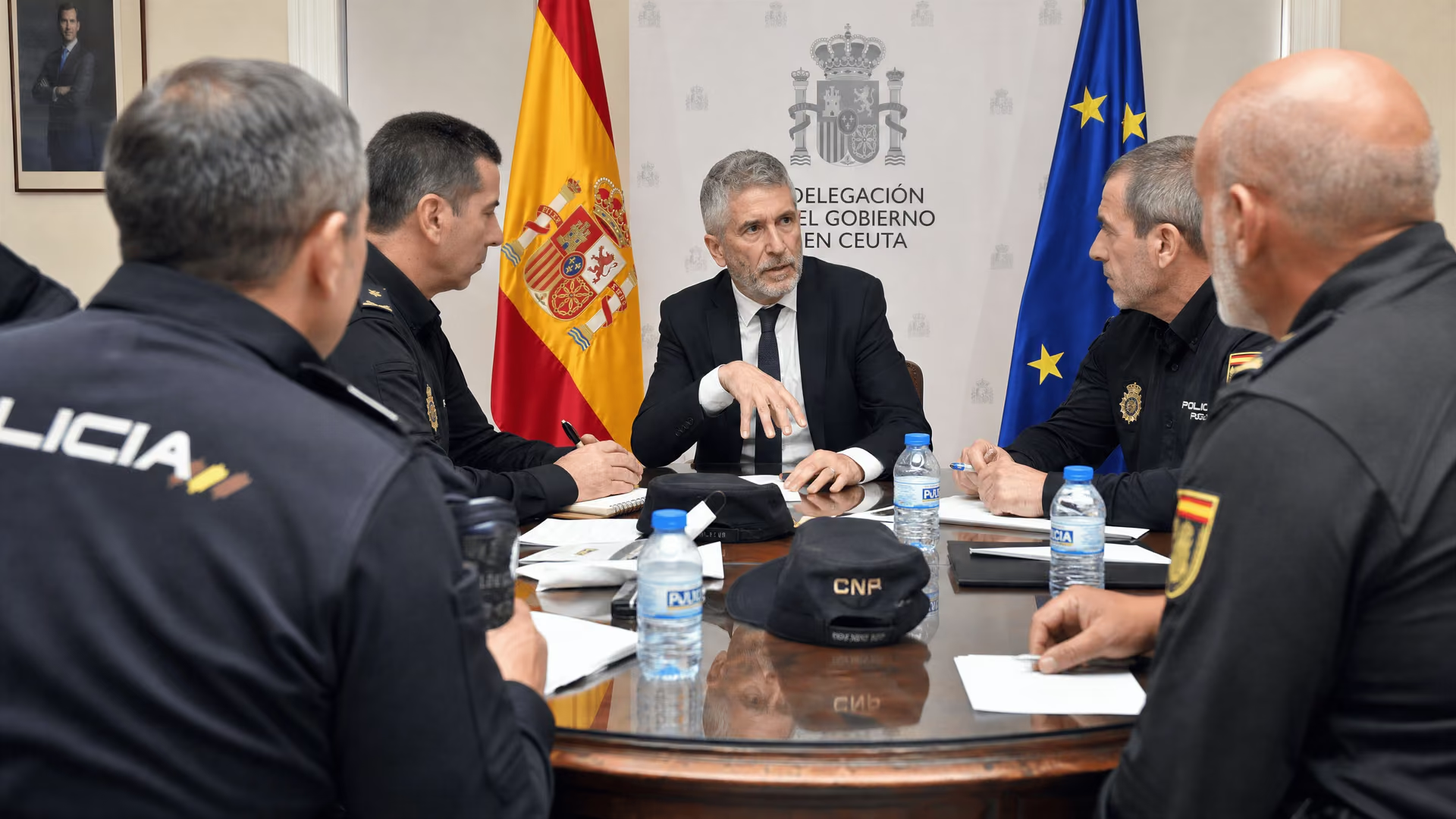
Marlaska made the statement at the Government Delegation in Ceuta after meeting police commanders responsible for the operation. Asked whether the intelligence services had warned that a mass assault on the border could occur, the minister answered: “No, there is no report regarding the situation that occurred.”
The distinction is central to the political dispute now forming around the crisis. The Ministry of the Interior is responsible for the custody of Spain’s borders, while the CNI is the country’s intelligence service. Government sources cited by La Vanguardia said Interior did not receive information indicating that thousands of people from several Moroccan cities were moving towards Ceuta in search of an opportunity to cross.
Those sources said the government was caught by surprise and suggested that the impact could have been reduced if relevant intelligence had reached Interior in advance. They also said that, at the beginning of the week, the ministry’s attention had been focused on fires affecting central Spain. That explanation does not establish whether a warning existed elsewhere in the state, only that Marlaska said no such report reached his ministry.
“No, there is no report regarding the situation that occurred.”
Fernando Grande-Marlaska, Spain’s Interior Minister
The question facing Spain’s institutions
Ceuta’s crisis escalated within days
The account presented by La Vanguardia describes an escalation rather than a single isolated crossing. Earlier in the week, Ceuta had been dealing with a continuing arrival of people swimming from Morocco. That movement was already placing pressure on the city’s reception system, but it had not yet reached the scale of the later influx.
The legal environment was also changing. Spain’s Supreme Court had recently ruled that summary “hot returns” could not be applied to migrants intercepted at sea while attempting to reach Ceuta or Melilla. The ruling did not create the mass movement described in the report, but it formed part of the operational context for authorities dealing with arrivals by water. The Supreme Court ruling on sea interceptions was reported by EFE.
The sequence described in the reporting
- Earlier in the week, arrivals by sea continued and added pressure to Ceuta’s already saturated reception system.
- By Thursday midday, the situation changed sharply, with hundreds of people entering both by swimming and on foot while Moroccan gendarmes appeared, according to the report, to be allowing the movement to continue.
- By Saturday, Marlaska had raised the government’s estimate of the influx to up to 60,000 people, while the city began trying to restore normal activity and manage returns through the El Tarajal border area.
The scale reported for the episode was far beyond the figures recorded during the first half of the year. Europa Press had reported 2,580 irregular entries into Ceuta during that period, with no maritime arrivals recorded in its account. That earlier figure provides context for why the later movement was treated as an extraordinary event rather than a routine increase.
The dispute over what Morocco knew
Marlaska has maintained that Morocco is not a threat to Spain and described Rabat as an “authentically reliable partner”. The Spanish government has also said publicly that Morocco cooperated throughout the crisis.
That position is being questioned by police sources quoted in the report. A Guardia Civil commander said there was no doubt that Moroccan authorities had detected buses arriving in Fnideq, also known as Castillejos, before they appeared to stand aside as the mass entry began. The source’s question was direct: if Morocco is a reliable partner, why was the information not shared with Spain?
The account does not present that allegation as an established finding by an inquiry. It presents a contrast between the government’s diplomatic assessment and the view of a police source familiar with the border operation. That contrast is important because the intelligence question extends beyond the CNI: it also concerns the information available to Moroccan authorities and whether any relevant warning was communicated to Spain.
| Position or development | What was reported | Source |
|---|---|---|
| Marlaska’s statement | The Interior minister said no report about the mass influx reached him or his ministry. | Marlaska says the CNI did not warn of the Ceuta influx |
| Legal context | Spain’s Supreme Court ruled that summary returns could not be applied to migrants intercepted at sea. | Supreme Court rules on returns at sea |
| Earlier 2026 arrivals | Europa Press reported 2,580 irregular entries during the first half of the year and no maritime arrivals in that period. | Ceuta records 2,580 irregular entries in 2026 |
“If Morocco is a reliable partner, why did it not share that information with Spain?”
Question attributed to police sources in La Vanguardia’s report
Ceuta begins to recover while the border remains under pressure
By Saturday, Ceuta was beginning to recover a degree of normality. Shops were reopening, although hundreds of Moroccan nationals remained in the streets after spending a second night outdoors. The report said that more people were returning to Morocco through the same El Tarajal breakwater where they had entered.
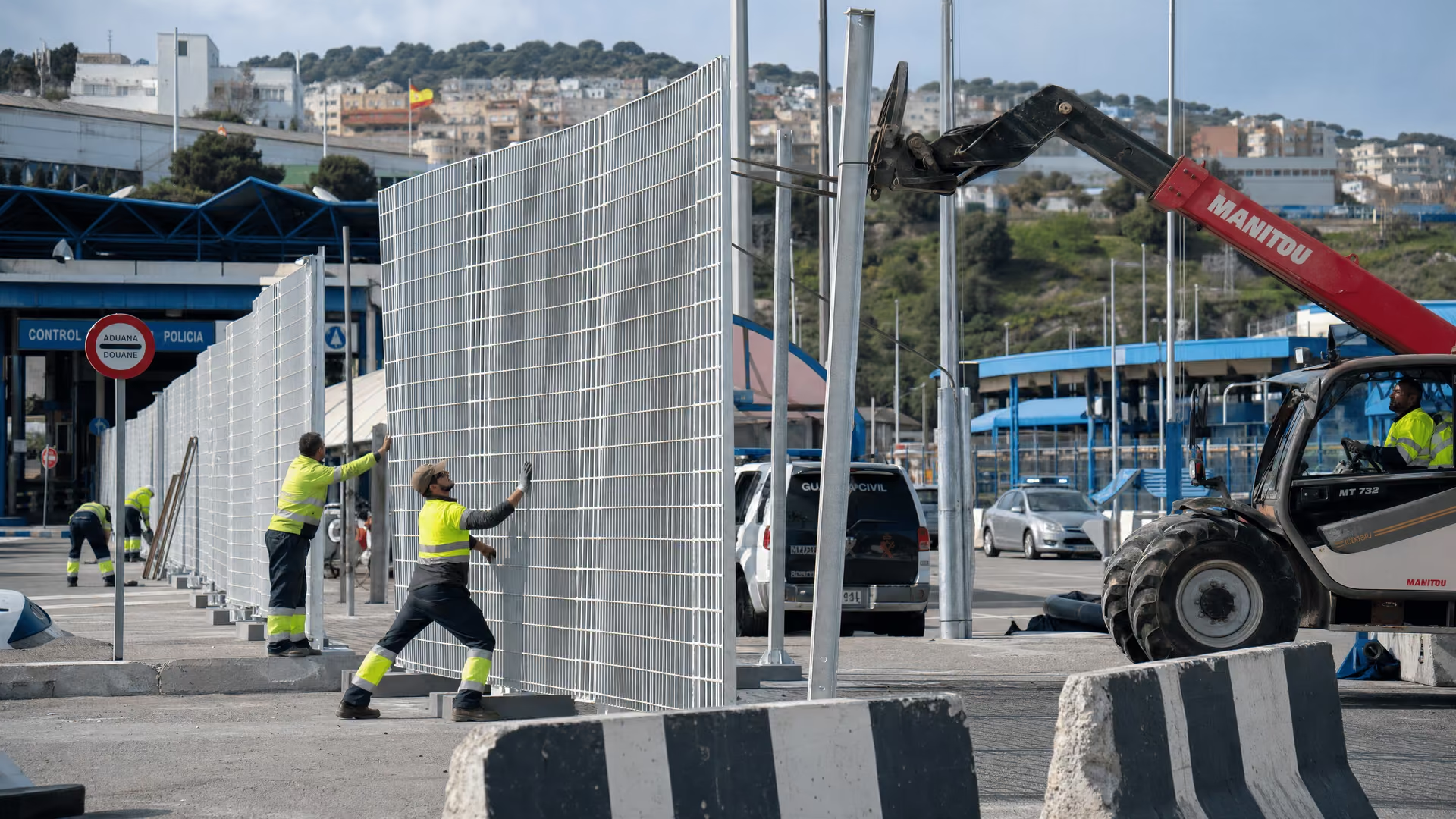
Authorities had begun installing containment barriers along the frontier. The structure was described as 500 metres long and intended to discourage further arrivals. Its installation is an immediate physical response, but it does not answer the prior question of whether the movement could have been identified earlier.
The human cost reported by La Vanguardia was at least 67 deaths. The episode also exposed the limits of Ceuta’s reception capacity: what had initially been described as a continuing but manageable arrival became a sudden influx that pushed local services beyond their normal operating conditions. Other reporting described the city as facing an emergency and documented pressure around the Temporary Immigrant Reception Centre.
The principal figures reported in connection with the episode are:
The immediate border response
What remains unanswered after the minister’s statement
Marlaska’s statement establishes the government’s position: the CNI did not provide Interior with a report warning of the mass influx. It does not, by itself, resolve whether information existed within other Spanish institutions, what Moroccan authorities knew before the crossings, or whether the border response could have been adjusted before Thursday’s rapid escalation.
For Spain, the accountability issue is therefore divided into several separate questions. One concerns intelligence collection and circulation. Another concerns the operational readiness of the border and reception systems. A third concerns Spain’s assessment of cooperation with Morocco, a partner that the government continues to describe as reliable even as police sources dispute whether information was withheld.
The questions now facing the authorities
- Whether any Spanish service identified the movement of people and buses towards Fnideq before the mass crossings began.
- Whether relevant information was passed to Spain’s Ministry of the Interior, which has responsibility for border custody.
- What Moroccan authorities knew about the approaching movement and why the information was, according to police sources, not shared.
- Whether earlier intelligence would have allowed Spain to reduce the pressure on Ceuta’s reception system and limit the scale of the crisis.
Those questions will determine whether the episode is judged primarily as an unexpected border emergency or as a failure to act on information that was available somewhere within the Spanish-Moroccan security relationship. For now, the public record contains Marlaska’s denial of an Interior warning, the government’s defence of Morocco, and a police account that challenges both the reliability of the information flow and the explanation for why Ceuta was caught unprepared.
Marlaska’s account places the immediate responsibility for the surprise on the absence of a CNI warning reaching the Ministry of the Interior. The competing accounts from government and police sources leave open the wider question of what Spanish and Moroccan authorities knew before the crossings began, and whether better information could have prevented Ceuta’s border and reception systems from being overwhelmed.
Sources
- Marlaska asegura que el CNI no alertó de la entrada masiva de inmigrantes que desbordó Ceuta (lavanguardia.com)
- El Supremo confirma que no se puede aplicar la devolución en caliente a migrantes que llegan por mar (efe.com)
- Ceuta registra la entrada de 2.580 migrantes de manera irregular en lo que va de año (europapress.es)